
The differences between types of twins
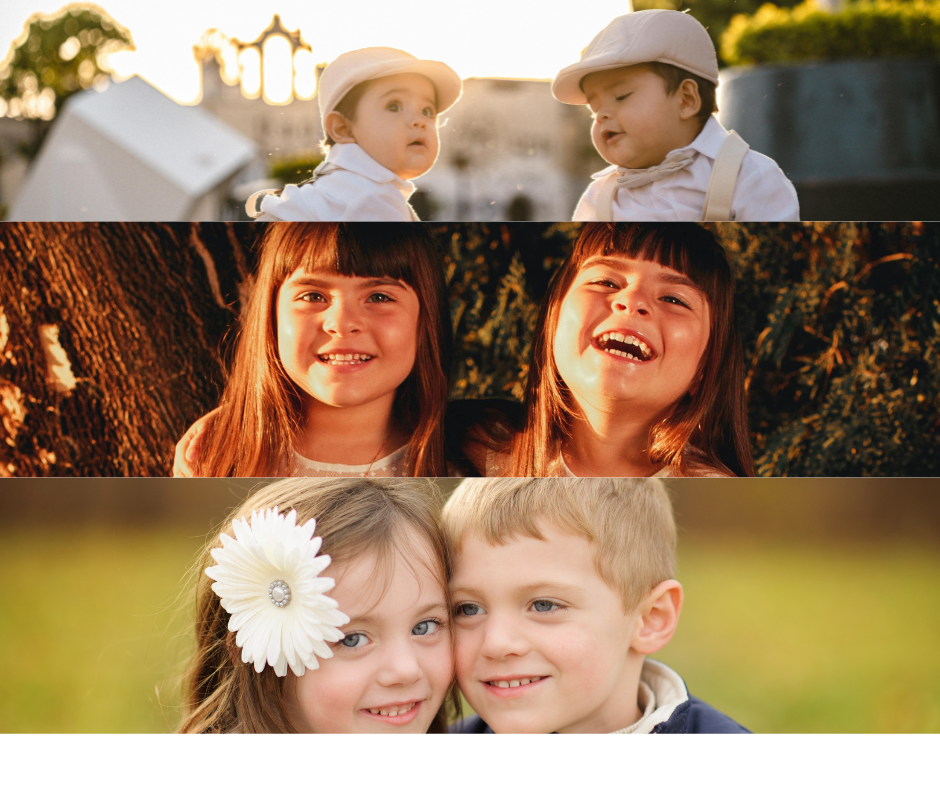
What types of twins can tell us about twin relationships
While every twin pair is different, some common themes can be observed in certain types of twins. So let’s unpack this.
There are 5 types of twins:
1. Identical (boys)
2. Identical (girls)
3. Fraternal (boys)
4. Fraternal (girls)
5. Fraternal (boy/girl)
Each of these pairs has slightly different relationships and dynamics. By understanding how the type of twins can impact children’s development, relationships, and experiences within and outside the twinship, parents and caregivers can better support each twin and set both up for success.
Identical twins:
Identical twins tend to be closer than fraternal twins (although not always). Parents often highlight similarities (whether consciously or subconsciously), and the intention to keep them close may influence decisions about separation and individuation. There is an inclination to see identical twins as “the same”, and parents and caregivers can thus lean into enhancing and accentuating their looks, show a preference for them doing things together, and celebrate synchronicity.
Research shows that identical girls have the closest relationship among the 5 types of twins. It potentially stems from girls’ natural disposition and parental influence to offer emotional support and to have a high regard for others’ feelings and needs. The girls may suppress personal needs and feelings to maintain their closeness (wary that their differences or disagreements may fracture the twinship bond or jeopardise their closeness).
How to help:
Parents’ support in helping identical twins express feelings and nurture individuality is imperative for both girls’ and boys’ pairs. Because their inclination might be to preserve their bond above having their individual needs met, or express their personal opinions and desires (i.e., pursue hobbies and interests, nurture friendships, assert boundaries and ask for space), the role of advocacy for each child’s right to be who they are, regardless of their co-twin’s feelings about it (not wanting to share, have personal toys and clothes, have playdates on their own, not wanting to play together/wanting space, etc.) is of utmost importance.
These actions can model to each child how to speak up, express their needs, and individuate without fear that their twinship will be affected. Sometimes, without us modelling this, twins can be reluctant to do so. Validating their feelings and needs in front of one another can be a powerful tool to help them learn to do this on their own when they are older, without feeling responsible for hurting their co-twin’s feelings, disappointing them, feeling obligated to take care of them, or accommodating their needs at the expense of their own.
Language development:
Language development can be delayed in all types of twins, and even more so in identical pairs. Twins’ closeness and ability to understand each other quite effortlessly can make verbal language development less of a priority, as they don’t need adults to understand them as frequently as singletons do. Some twins even develop their own language (Cryptophasia).
Twin boys' language development tends to be the slowest among all types of twins. That’s because boys often develop “slower” than girls (it is all relative), and this can be more obvious in twin boys’ speech.
Fraternal twins (same sex):
Fraternal twins are easier for parents to mentally individuate, which helps their sense of self and balances the dynamic of twinship and personal identity.
In contrast to identical twins, there can be an inclination to see fraternal twins as opposites: fussy/easygoing, slow/fast, good eater/picky eater, patient/impatient.
These comparisons and opposing views of each twin’s personality, attributes, and feelings can foster competition, and an incomplete and inaccurate self-perception in twins. They can thus learn to see their development, milestones, achievements, and challenges in relation to their twin’s rather than in relation to their own personal journey. Ongoing experiences such as these can wire the children to look outwards (toward their twin) for validation, confirmation, a measure of “good/bad,” and to derive their sense of accomplishment and worth from theirs.
Same sex twins (identical/fraternal):
It makes sense to feel/think that same-sex twins are “closer” than opposite-sex twins, or we would like to help them be closer. Our human brain naturally seeks patterns in everything we see and do, and when seeing twins of the same sex, our brain “groups” them as “together”.
Yet when each twin feels that their likes or dislikes are measured against or in relation to their co-twin (for better or worse), they can struggle to maintain a healthy sense of self-esteem, where their accomplishments and “failures” are theirs and not influenced or impacted by their co-twin.
It is one thing to feel “different” to your opposite sex co-twin. Yet when a particular skill, trait, habit, behaviour, or look seems to be “preferred” by parents/ caregivers/ onlookers, it can be harder for twins to “shake off” the feeling that they are doing it, or that they are “wrong”. (Disclaimer: this isn’t easy for any type of twins).
Simply because they are of the same sex does not automatically mean they will be similar in taste, temperament, needs, or skill. And just as anyone with siblings knows: siblings aren’t necessarily going to grow to be friends. It isn’t a given.
Pressure to maintain a close bond and sameness, or heightened competition between twins in childhood, can lead to a more abrupt separation later in life (adolescence or early adulthood), as well as to feelings of frustration, resentment, and even anger toward one’s twin. Years of suppressed feelings, comparisons, or pressure to care for one another and be close can feel like too much at this stage in life.
Impact in later years:
Adolescence is an age of asserting one's identity, independence, and rebelling against what one has grown to know as “truth” or “expected”. It is a time when many people experiment with boundaries, struggle with identity, and question many aspects of their immediate environments.
It is no surprise, then, that twins will want to branch out, differentiate, and experience more separation (physical, emotional, and mental). The process doesn’t always hit both children in the same way or at the same time, and it can be more painful for one of the twins. The underlying themes we have addressed so far in this article will surface (conscious or unconscious) and exhibit in different ways as the twins try to assert their identity and understand who they are.
We can help mitigate some of this in early childhood, so the transitions aren’t so drastic, and feelings aren’t left unprocessed for so long.
While we can’t avoid all tension between the twins, we can definitely reduce the friction and intensity by setting them up for success early on and giving them strategies, tools, and language to share their feelings, ideas, thoughts, and needs.
Fraternal boy/girl twins:
These twins tend to be less affected by pressure to maintain closeness. Yet many of the fraternal twins' struggles can be evident in early childhood (such as comparisons and competition).
It is important to remember (as mentioned above) that boys tend to develop more slowly than girls in many areas, and developmental gaps can be more obvious in this type of twins. Twin boys may seem delayed, and comparisons are best avoided in these cases. As Magda Gerber wisely said: “Everyone reaches milestones in their own way and in their own time”.
Twin girls might be assigned a Caretaker role, and boys a Protective Brother role. These roles often stem from familial expectations and social discourse regarding gender roles and attributes. Parents’ awareness of their own biases and notions regarding gender roles can help them consciously avoid some statements, expectations, and other forms of communication to the children regarding their “role” in the twinship.
Their biological differences allow each twin to develop a strong sense of self, leading to a more gradual and organic separation later in life. They will likely each foster a group of friends and more easily pursue personal interests and passions, not as strongly affected by their co-twin’s choices and decisions as other types of twins.
Some boy/girl twins remain close friends throughout their lives, yet co-dependency and emotional alliances are less prevalent in this type of twins.
Interesting to know: While extremely rare, identical girl/boy twins do exist! Though they will likely be closer in nature than fraternal opposite sex twins, their relationship will resemble more that of fraternal girl/boy twins.
The main takeaway - types of twins and impact on DEVELOPMENT and Relationships:
Comparisons between twins (regardless of their type) can distort each child’s sense of self, worth, and identity. They can also build resentment, anger, and frustration, along with a sense of obligation and responsibility to one another.
When emphasis is placed on who we are in relation to another person, we will grow to live in their orbit for validation, acceptance, company, support, and construct our sense of self in, or in contrast to, their image.
Our awareness and support can help each child thrive side by side, as a twin, and as an individual.
They can then both live up to their full potential: confident in who they are, what they want, and who they would like to become