
5 Ways to Reduce Twins’ Fighting
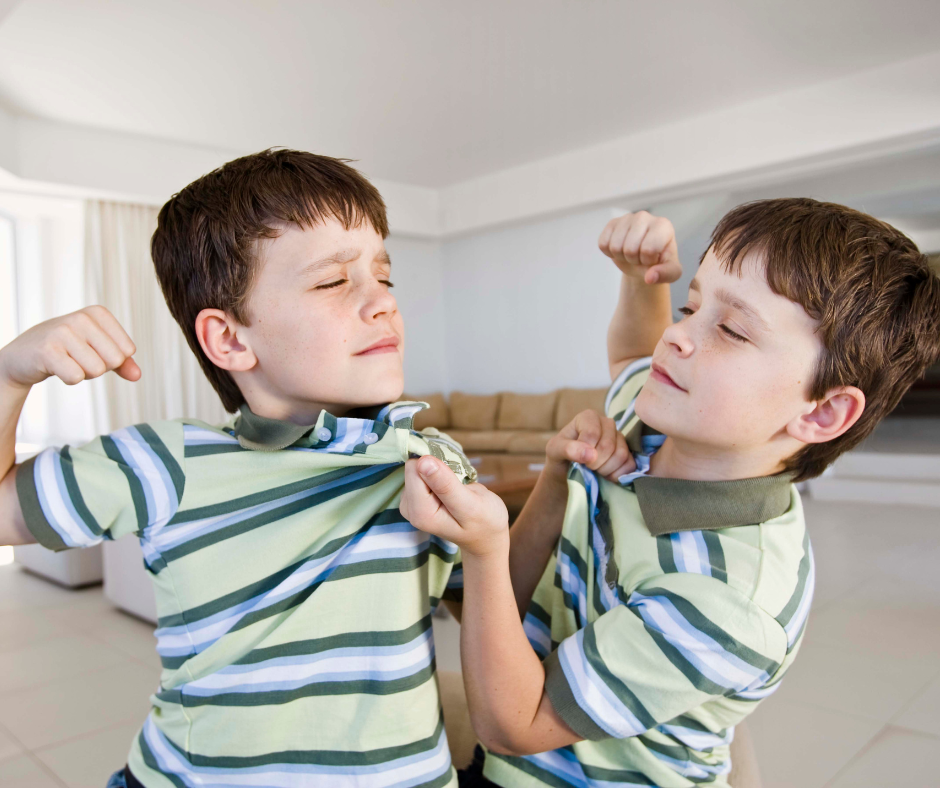
How to help twins fight less
Twins may be best friends, but even best friends fight. While we can’t force twins to get along, we can help them navigate their conflicts with productive strategies, and proactively reduce tension so things won’t escalate.
1. One-on-one time
While this isn’t always feasible for some families, striving to find moments throughout the day or the week to spend with each child will go a long way. It can be a precious moment of reading a book, taking one to do the groceries, or playing their favourite game. Making one-on-one time a routine will help twins have necessary breaks from their shared time and activities, which will restore tolerance and patience, and will allow them to enjoy your undivided attention, which they crave.
Proactively offering twins breaks from each other, and facilitating time to build relationships with their caregivers, will nurture their emotional well-being and fill up their tanks to endure conflicts, frustration, and disappointments when they arise.
2. Twins need things of their own
Twins share a lot. Almost everything. We sometimes expect them to naturally want to share, because they are twins. It can be an explicit or implicit expectation, given that they are the same age, may have similar interests, and we want them to care for each other’s feelings.
Yet there are two main issues with these well-meaning parental expectations.
First, children can’t really share before they are 3-4 years old. Understanding others’ feelings, choosing to part with a toy/food/object, and inviting others to participate in their play are socio-emotional skills that children need time to cultivate and acquire.
As the wise Magda Gerber said, “making a child share isn’t sharing”. If your twins share because you tell them to, or because you made them feel bad for not sharing, the act itself isn't sharing. They are doing it to please you and/or avoid being told off. Sharing should be a choice, not a chore. If twins feel obligated or made to feel guilty for not sharing, they aren't doing it out of the kindness of their hearts, because they care, but rather as an internalised pressure to maintain things “right” and to be “good”.
Second, twins don’t have to share everything. Singletons may share with their siblings, friends, classmates, etc... but not always, and certainly not everything. I argue that twins should enjoy the same privileges. While it makes sense, they will share more than singletons, as they may share a room and toys as they are the same age, yet ensuring they have things that are just theirs is paramount for their sense of self and autonomy.
Knowing they will have toys, clothes, and things which they can call their own, which they know they do not have to share, can provide an incredible sense of relief, authority, and agency.
Not only does it make sense, as we all have things that are just ours, but it will also make the times they do need to share easier and more tolerable.
3. Learn problem-solving Skills
Children learn that they cannot always have what they want as they interact with others. They learn that others have needs and wants, and they might clash with theirs. Sometimes they can play with something, sometimes others want a turn. Sometimes they can go first, sometimes they need to wait. It’s part of living with others, and it’s a natural process of learning all children go through., Frustrating as it may be, the only way to learn the rules and how to deal with the conflicts that arise is to face them.
Now, parents naturally want to help children solve conflicts and maintain peace and order in their household. Hearing children fight automatically gets parents onto their feet to check who did what, who needs to let go, who needs to share, etc...
Yet children need to learn what fair means to them. Our innate sense of justice can get in the way of children figuring out how to handle complex situations, negotiate, express feelings, and problem-solve.
If we jump into action at the first sound of conflict, children will learn that our presence is needed in order to solve the problem at hand. They will naturally internalise that they cannot figure this out, they do not have the skill or judgment to solve this, and someone has to step in to ensure peace is restored.
The main issue with this well-meaning habit we adults have, is that children will then quickly escalate to crying, whining, and screaming – to get us to intervene. They will, understandably, not try to talk, find a solution, or problem-solve, but rather pull, yank, push, and get physical to either get what they want, or to get someone to fight their fights.
To help twins, who spend a lot of time together and therefore are bound to have more conflicts over objects, turns, space, food, etc, to fight less and collaborate more, we ought to offer them opportunities to achieve this.
We do this right from the start, at infancy, through toddlerhood, and all the way to early childhood, as vocabulary increases, and the logical brain begins to develop and mature.
Normalising healthy conflict resolution strategies is key. When conflict ensues, remain calm, stay nearby, or get closer, but do not intervene. Observe. Who wants what, and how is the scene unfolding? For babies and toddlers, narrate the situation (sportscasting). Give the babies words for what is happening, reflect feelings, and offer solutions.
This will entail letting go, sharing, waiting, and finding something else to do. It’s not about solving the issue for them, but rather understanding what the issue is, how both of them are feeling about this, and what their options are in this situation. Then, comfort the upset twin. Hold space for their feelings, let them feel the frustration, anger, sadness, and name these feelings.
In conflict, it is important to know how to handle our feelings. For babies and children, it’s important to know what these feelings are, how to face them, how to process them, and how to get the support they need to regulate themselves. It starts with co-regulation with a supportive adult, and then evolves to self-regulation and finding strategies to handle challenging situations and feelings in a healthy and productive way.
By allowing babies and children to process these feelings, and understand how others feel when we act in a certain way, the twins will learn how to handle conflict without getting physical and loud, how to express their feelings and needs, and how to solve their conflicts on their own.
What is fair for us isn’t what is fair for another. Therefore, projecting our ideas of who needs to have a turn, who needs to let go, and who needs to share can feel arbitrary to children, and also, not as relevant. When supported well, children will figure out solutions that feel right to them. They might not mind waiting another turn, or choosing another toy. They might not care if they didn’t get their way right away, and they might do. What’s important is that they reach a solution that they feel good about, and if this isn’t possible after negotiating with their co-twin, then they can come to us for support, talk about their feelings, and be comforted. They will try again next time, or they might fight harder for what they want. And fighting isn’t necessarily bad, as long as it is done productively and respectfully. Then it essentially transforms into arguing.
4. Foster twin differences as positive
Helping twins identify and appreciate their differences can help with twin rivalry.
If twins always strive for sameness, they might feel resentful if they feel they can’t measure up to their co-twin in looks, achievements, social acceptance, skills, and so on and so forth.
While they may feel similar competence in certain areas, being different is natural, and learning to feel comfortable, and better yet, proud of your differences, can be a bit more challenging for twins.
It starts from the parents, and how they view and nurture the twins’ sameness and differences. If twins feel their parents prefer sameness, they are likely to lean into it and accentuate it. It makes sense, after all, the reactions to the stress from strangers to the sight of two matching people, in looks and outfits, nurture that sense of importance and specialty. Yet twins aren’t the same. Even if they are identical and have similar personalities, they are still two individuals. Helping twins identify where one ends and the other begins can help them develop a healthy sense of self-esteem, identity, and confidence.
This will help them process feelings of jealousy, resentment, frustration, anger, and disappointment, which can stem from intertwined identity and a strong need to maintain closeness and sameness.
When twins know they are two individuals, who may look alike, or may be similar in nature in certain things, they can better handle twinship tensions, feel secure in who they are, and be less triggered by their co-twin's actions and behaviours.
While challenges may occur, as in all relationships, having a strong sense of self and feeling confident in who they are as a person, not just as a twin, will help reduce tension and rivalry.
5. Manage twin expectations: 2 of everything isn’t a solution
Building on the previous 4 strategies, Managing Expectations is a culmination of how twins can expect others to interact with them, and around them.
Many twin parents resort to getting 2 of everything to avoid arguments and fighting. While this can work as a band-aid in the first couple of years, it has 2 main underlying problems that will manifest later in life as bigger issues.
First, it sends the twins a very clear message stating, “You are the same.” As we’ve uncovered already, this isn’t true. Twins are 2 individuals, and they deserve our acknowledgment, and even more so, our affirmation of this truth. It will help them anchor in their sense of identity. So, by giving 2 of everything, whether it’s clothes, toys, food, forms of affection, or presents, twins will internalise this as “the right way” of being, and any deviation from sameness is not okay. Then, when they would like to explore personal interests or ideas, they may lack the confidence to do so. They might only do things in tandem to maintain fairness and equality in their relationship. Giving up on their desires and interests can lead to resentment and frustration, which will build up and manifest in anger bursts and fighting.
Second, by giving 2 of everything, we essentially condition twins to expect having 2 of everything at all times. So if one gets something, they will assume another identical object will be produced for them. After all, that is the way we do things in here...
This expectation isn’t realistic. Not only is it hard to maintain at home at all times, it will not be met elsewhere (daycare, school, playground, playdates, etc..). This can be rather difficult for twins to have to deal with this disappointment. Because by giving them 2 of everything, they never get the opportunity to learn to deal with feeling let down, with being upset, with not having what their co-twin has. It is unfair to expect twins to magically learn how to deal with this situation at late toddlerhood or early childhood. Singletons get to experience this challenge early on. It’s a natural learning process. However, twins bypass this lesson when we choose conflict-aversion over a natural development process.
Understandable as it may be, we are not doing twins a favour by avoiding them fighting over things. We delay an organic learning process, and we may make things more challenging later on. Moreover, we are enhancing a strong sense of sameness and unity in their identity, which can be somewhat challenging to address later in life, as it becomes part of their personality make-up.
So, by managing micro-conflicts over toys (by not offering 2 of everything, promoting problem-solving skills, offering one-on-one time, and giving twins things of their own), we can reduce conflict and fighting in the long run. We help twins strengthen the muscles of facing challenges, dealing with disappointment, while also fostering a healthy sense of individuation and ownership. Twins do not have to share everything, let alone have identical clothes, toys, and experiences, lest they feel jealous and upset. Learning they are special for being twins, but no less special for being themselves, will help them feel secure in who they are, better face challenges, and reduce conflict.
You can learn more about managing twins’ behaviour in my Twin Toddlers’ Masterclass.